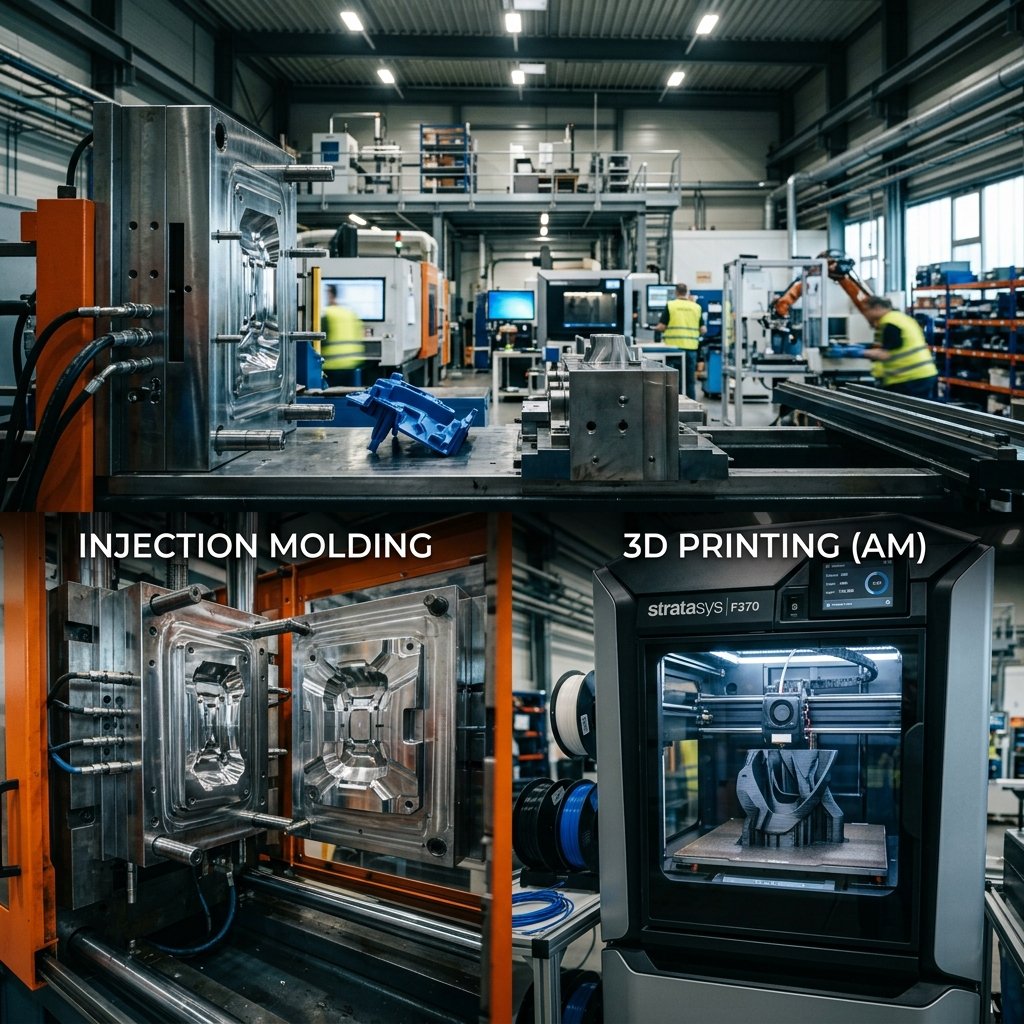
So, you’ve got a killer idea. You’ve burned the midnight oil perfecting the CAD file, and it looks awesome on your screen. But now comes the real challenge: how do you actually manufacture the physical part? If you’re dealing with plastics, you’re almost immediately going to hit the big crossroads: 3D Printing or Injection Molding?
This isn't just a matter of picking a cool piece of machinery. It’s about figuring out where your product is in its lifecycle, what your budget looks like, and honestly, how many of these things you plan on selling. Let’s cut through the tech-bro hype and break down the gritty reality of both methods so you can make the right call.
The Agile Innovator: 3D Printing
Think of 3D printing (additive manufacturing) like an incredibly smart hot glue gun. It takes your digital file and builds the part from the ground up, layer by layer. No massive steel tools, no complicated setup—just slice the file and hit print.
- The Good: It is ridiculously fast for prototyping. If you need to hold a physical model in your hands by tomorrow morning to show an investor, 3D printing is your best friend. It’s also killer for wild, complex geometries that you physically couldn't mold—like hollow internal lattice structures. Best of all, if you need to tweak the design, it costs you zero dollars. You just adjust the CAD and print it again.
- The Catch: It flat-out doesn't scale. If you need to crank out 5,000 units, printing them one by one is going to take months and cost a fortune per part. Also, printed parts have a dirty little secret: they're inherently weaker along the layer lines, meaning they can snap under stress. And unless you’re paying for super high-end SLA printing, you’re going to be dealing with ugly layer lines that require a ton of sanding and elbow grease to look decent.
The Heavyweight Champ: Injection Molding
Injection molding is the undisputed king of mass production. It’s old school, it’s heavy industry, and it works. You melt plastic down and ram it into a custom-machined steel block under insane pressure.
- The Good: Unbeatable economics at scale. Once your mold is cut, the machine can spit out 10,000 parts at literally pennies a piece. The speed is mind-blowing—you might get a finished part every 15 seconds. On top of that, molded parts are incredibly strong, perfectly consistent, and look gorgeous right out of the machine. Want a high-gloss finish? A leather texture? Crystal clear? Molding does it effortlessly.
- The Catch: The upfront cash and time. Machining a steel mold (the "tool") requires serious engineering and serious money. We’re talking thousands of dollars before you make a single part. And if you suddenly decide a button needs to move half an inch to the left after the steel is cut? You’re in for a really expensive, painful fix. It is absolutely not for early prototypes—it’s for your finalized, ready-for-market product.
The Verdict: Which Way Do You Go?
Honestly, the decision usually boils down to a pretty simple question: Where are you at with your product?
- Prototyping & Early Testing: 100% go with 3D Printing. Iterate fast, fail on the cheap, and get your design dialed in without dropping cash on expensive tooling.
- Super Low-Volume or Custom (1-100 units): 3D printing still probably wins here. Especially if each piece needs to be a little different, like medical prosthetics or custom jigs.
- Mass Production (1,000+ units): Injection Molding takes the crown. The hefty upfront cost of the mold is quickly swallowed by the dirt-cheap cost of each individual part, giving you the profit margins you actually need to run a business.
Bridging the Gap
Here at FD Group, we don’t really see it as an "either/or" situation—we use both all the time. When guys bring us a new project, we heavily rely on 3D printing during the engineering phase to validate the fit and feel. Once we all agree the design is absolutely bulletproof, we transition over to injection molding to crank up the volume. If you know how to play the strengths of both methods, you get rapid innovation up front and highly profitable, bulletproof manufacturing on the back end.